Hybrid vs EV costs in Mexico: a practical ownership comparison
In Mexico, a full electric vehicle can cost substantially less per kilometer than a hybrid when it is charged mostly at home without pushing the household into the Domestic High Consumption tariff (DAC). A hybrid can still cost less overall when it has a much lower purchase price, the EV depends on expensive public charging, or the buyer cannot recover the home installation and depreciation difference during the ownership period.
This is the cost-focused continuation of our guide to choosing between a hybrid, plug-in hybrid, and full EV. That article starts with lifestyle and charging access; this one turns the decision into Mexican pesos.
All monetary examples below are illustrative and use information available on August 30, 2026. Fuel prices, CFE tariffs, incentives, insurance quotes, and vehicle offers change, so replace every assumption with your own bill or written quote before buying.
The short answer for Mexico
| Situation | Cost advantage usually favors |
|---|---|
| Home charging, favorable domestic tariff, high annual mileage | Full EV |
| No home or workplace charging | Conventional hybrid |
| Daily travel fits the electric range and the PHEV is charged consistently | Plug-in hybrid can work |
| Low annual mileage and a large EV purchase-price premium | Hybrid |
| Household is close to its CFE high-consumption threshold | Calculate carefully before choosing an EV or PHEV |
| Frequent paid DC fast charging | Compare exact network prices; the EV advantage can shrink |
| Buyer changes cars every two or three years | Depreciation and financing may matter more than energy |
The powertrain does not decide the final cost by itself. The largest variables are often purchase price, financing, depreciation, insurance, and access to inexpensive charging.
A worked annual-cost example
Consider a driver traveling 15,000 km per year. These are comparison assumptions, not ratings for a particular car:
- Gasoline: $24 MXN/L, consistent with the federal 2026 strategy to keep regular gasoline below that level (National Energy Commission, August 2026)
- Home electricity: $3.50 MXN/kWh, an illustrative value also used in a 2026 BYD Mexico cost-per-kilometer disclosure—not a universal CFE tariff (BYD methodology)
- BEV wall consumption: 18 kWh/100 km, including an allowance for charging losses
- Hybrid efficiency: 20 km/L
- Gasoline-only vehicle efficiency: 14 km/L
- PHEV: 70% of kilometers electric at 18 kWh/100 km and 30% at 18 km/L
| Vehicle | Annual energy | Annual energy cost | Cost per km |
|---|---|---|---|
| Full EV | 2,700 kWh | $9,450 MXN | $0.63 MXN |
| Plug-in hybrid | 1,890 kWh + 250 L | $12,615 MXN | $0.84 MXN |
| Conventional hybrid | 750 L | $18,000 MXN | $1.20 MXN |
| Gasoline-only vehicle | 1,071 L | ~$25,714 MXN | ~$1.71 MXN |
Under those assumptions, the BEV saves about $8,550 MXN per year in energy versus the hybrid. If the BEV costs $100,000 MXN more after incentives and financing is ignored, energy alone would take almost 12 years to recover that difference. At 30,000 km per year, the same energy advantage would recover it much sooner.
This is why “electricity is cheaper than gasoline” is not the same as “the EV is the cheapest car to own.”
Calculate electricity from the CFE bill, not an internet average
CFE domestic tariffs vary by locality, climate classification, season, and consumption block. The relevant cost for charging is the marginal price of the additional kWh, not simply the current bill divided by household consumption.
Use this formula:
EV charging cost = distance ÷ 100 × wall consumption in kWh/100 km × marginal electricity price
Wall consumption should include charging losses. If the vehicle displays 15 kWh/100 km while driving, the meter can record more energy than the battery receives. A cautious first estimate can add 10–15%, then be replaced with actual meter readings.
For the example BEV using 2,700 kWh per year:
| Effective charging price | Annual electricity cost | Cost per km |
|---|---|---|
| $1.50 MXN/kWh | $4,050 MXN | $0.27 MXN |
| $3.50 MXN/kWh | $9,450 MXN | $0.63 MXN |
| $6.00 MXN/kWh | $16,200 MXN | $1.08 MXN |
The table shows why the tariff matters. At an expensive effective rate, the EV can retain an energy advantage over the example hybrid, but the margin becomes much smaller.
The DAC risk can change the calculation
CFE classifies a household as Domestic High Consumption based on its 12-month rolling average. The threshold depends on the locality’s tariff: the published monthly limits range from 250 kWh for Tariff 1 to 2,500 kWh for Tariff 1F. DAC does not receive the ordinary domestic subsidy (CFE DAC tariff).
In the worked example, EV charging adds an average of 225 kWh per month. A Tariff 1 home already averaging 150 kWh per month could therefore cross the 250 kWh DAC threshold if charging is added to the same meter. A household on a hot-climate tariff may have a much higher threshold, but air-conditioning consumption must also be considered.
Before installing a charger:
- Check the tariff code and kWh on the last 12 months of CFE bills.
- Add the EV’s expected monthly wall consumption.
- Compare the new average with the official DAC threshold for the locality.
- Ask CFE whether a separate service and meter is appropriate.
- Obtain a load assessment and installation quote from a qualified electrician.
CFE publishes a process for a second meter dedicated to an electric or plug-in hybrid vehicle charger and instructs users to keep that preparation isolated from the home’s electrical installation (CFE electrolinera guidance). A separate meter is not automatically the least expensive solution: its contract, tariff, electrical work, and fixed charges must be quoted for the actual address.
Home charger and electrical installation
The charger itself may be included with the car, sold separately, or bundled with a limited installation. The real project cost can also include:
- Dedicated circuit, breaker, protection, wiring, and conduit
- Longer cable run from the service entrance to the parking space
- Grounding corrections or electrical-panel replacement
- Load increase or a second CFE meter
- Civil work, permits, condominium approval, or assigned-parking access
- Surge protection and a charger suitable for outdoor exposure
Get a written scope showing charger power, voltage, maximum current, protections, cable distance, warranty, and whether future upgrades are possible. A slow but adequate overnight installation may be cheaper than paying for the highest power the car can accept.
For renters or apartment residents, the cost is not only equipment. Permission, shared electricity billing, and the risk of losing the installation after moving can favor a hybrid even if electricity per kilometer is cheaper.
Public charging is a convenience price, not a CFE household tariff
Public networks can charge by kWh, time, session, parking, or a combination. Prices can also vary by charging power and membership. A free charger may be occupied or restricted to customers, while DC fast charging may cost far more per kWh than home charging.
Build the ownership budget using the expected mix:
Blended charging price = home share × home price + workplace share × workplace price + public share × public price
If 80% of energy comes from home at $3.50 MXN/kWh and 20% from a network at $9.00 MXN/kWh, the blended energy price is $4.60 MXN/kWh. Use current prices from the networks on the routes you actually travel and include parking fees.
Gasoline cost for a hybrid
Use actual fuel receipts or the current station-level data from Profeco’s Quién es Quién en los Precios de la Gasolina. The portal uses prices reported by permit holders and warns that they can change.
The formula is:
Hybrid fuel cost = annual distance ÷ real km/L × gasoline price per liter
Do not use a single best-case dashboard trip. Calculate several tanks across city, highway, air-conditioning, hills, and normal traffic. For a PHEV, calculate electric and gasoline kilometers separately. A PHEV that is not charged regularly may behave financially much more like a conventional hybrid while still carrying a higher purchase price.
Maintenance in Mexico
A BEV removes oil changes, spark plugs, engine filters, exhaust components, and many transmission services. It still needs tires, suspension, alignment, cabin filters, brake fluid, air conditioning, 12-volt components, and battery thermal-system attention. A hybrid retains engine and emissions maintenance in addition to its high-voltage system.
Price matters, but service access matters too. Before buying, request from the local dealer:
- The complete scheduled-maintenance table through at least five years or 100,000 km
- Current prices for each scheduled service and what they include
- Battery, inverter, motor, and thermal-system warranty terms
- Nearest high-voltage-certified workshop
- Typical availability of tires, body parts, windshield, lights, and charging components
- Roadside-assistance and towing conditions
An inexpensive service visit does not compensate for a car waiting months for a collision part. This affects both insurance and resale, particularly for new brands with a small repair network.
Insurance costs must be quoted by exact version and postal code
There is no defensible national rule that an EV costs a fixed percentage more—or less—to insure than a hybrid. Premiums depend on purchase value, theft history, repairability, parts, driver, postal code, deductible, financing requirements, and coverage.
Use the CONDUSEF insurance comparison tools and request direct quotes for the exact model and version. Compare more than the premium:
- Agreed, commercial, or invoice value
- Deductible for material damage, theft, glass, and battery damage
- Explicit coverage for the high-voltage battery and charging cable
- Damage to the home wall connector or third-party charging equipment
- Towing to a certified high-voltage repair center
- Replacement-car days and parts-wait exclusions
- Flood, water ingress, underbody impact, and road-hazard conditions
Financed vehicles may require broad coverage throughout the loan, so insurance should be included in the financing comparison from the first year through the final payment—not only the promotional first year.
Purchase price, financing, and federal tax treatment
Compare the cash transaction price, not an advertised monthly payment. Record the down payment, opening fee, mandatory insurance, accessories, total interest, balloon payment, and total amount paid. A manufacturer discount tied to financing may still cost more than a smaller cash discount with cheaper credit.
At the federal level, Article 8, section IV of Mexico’s New Automobile Tax law exempts electric vehicles and electric vehicles that also have an internal-combustion or hydrogen motor from ISAN. SAT’s 2026 documentation continues to identify this exemption (SAT 2026 annex). Verify that the exact model and invoice treatment qualify; an ISAN exemption does not mean the vehicle is exempt from VAT, registration fees, or every state tax.
State benefits differ. Registration, license plates, ownership tax or refrendo, verification, and circulation rules depend on where the vehicle is registered. They can also distinguish BEV, PHEV, strong hybrid, and mild hybrid.
For example, Mexico City maintains an official model list for the Exempt hologram. Eligible electric and Category I or II hybrid vehicles can receive verification and Hoy No Circula benefits, but the exact submodel must appear on the list (SEDEMA eligible-vehicle list). Do not assume that every vehicle advertised as “hybrid” qualifies.
Second-hand value in Mexico
Mexico’s electrified used-car market is growing but remains less mature than the gasoline market. Resale depends heavily on brand recognition, service coverage, new-car discounts, battery warranty, parts supply, charging standard, and buyer confidence.
For a new-car buyer, aggressive future discounts can reduce resale value. For a used-car buyer, the same depreciation can create an opportunity. Either way, do not use a global depreciation percentage as a Mexican forecast.
Before buying, compare the actual asking and trade-in values of two- to five-year-old examples using a current local guide such as Guía Autométrica via Autocosmos, dealer trade-in quotes, and listings that show how long vehicles remain for sale. Asking price is not the same as completed sale price.
For a used BEV or PHEV, add these checks:
- Independent battery state-of-health report when available
- Remaining battery warranty and transfer conditions
- Successful AC and DC charging test where applicable
- Underbody and battery-enclosure inspection
- Diagnostic scan, recalls, and software support
- Included charging cable and locally supported connector
For a used hybrid, request the hybrid-battery diagnostic plus complete engine, cooling, transmission, and emissions-service history.
A simple five-year cost method
No single national five-year total is defensible: the result changes with the exact model, financing quote, postcode, CFE tariff, insurance profile and resale assumption. Compare candidates with the same distance and ownership period using this formula:
Five-year ownership cost = purchase price + financing and fees + fuel or electricity + charging equipment + scheduled maintenance + tires + insurance + registration/taxes/verification − expected resale value.
For example, if a vehicle costs MXN 520,000, financing and fees total MXN 80,000, energy costs are MXN 120,000, maintenance and tires total MXN 55,000, insurance and taxes total MXN 95,000, and expected resale is MXN 260,000, the estimated five-year cost is MXN 610,000. Replace every input with the candidate’s actual quotes and your driving pattern; the example is an illustration, not a market average.
Run at least three scenarios:
- Expected: current mileage and energy prices
- High-cost EV: more public charging, higher electricity tier, conservative resale
- High-cost hybrid: higher gasoline price, more mileage, conservative resale
The decision is robust only if the same vehicle wins under reasonable changes in the assumptions.
Final recommendation for Mexico
A full EV is financially strongest when there is inexpensive home charging, the household avoids an unfavorable tariff change, annual mileage is moderate or high, and the buyer keeps the vehicle long enough to benefit from lower energy and maintenance costs.
A conventional hybrid is often the safer cost choice when home charging is unavailable, annual mileage is low, long trips are frequent, or the EV carries a large purchase, insurance, or depreciation premium.
A PHEV can work when most daily kilometers are electric and the owner plugs in consistently. Without that habit, paying for two powertrains is difficult to justify.
Start with the last 12 CFE bills, real annual kilometers, two insurance quotes per vehicle, a written charger-installation estimate, dealer maintenance schedules, and conservative resale values. Those six inputs will produce a more useful answer than any national average.
Sources
- CFE: Domestic High Consumption tariff and locality thresholds
- CFE: second-meter process for home EV charging
- Profeco: Quién es Quién en los Precios de la Gasolina
- National Energy Commission: 2026 regular-gasoline price strategy
- SAT: 2026 ISAN documentation
- Mexico City SEDEMA: vehicles eligible for the Exempt hologram
- CONDUSEF: comprehensive auto-insurance comparison
- INEGI: Administrative Registry of the Light-Vehicle Automotive Industry
- Autocosmos/Guía Autométrica: used-car price guide
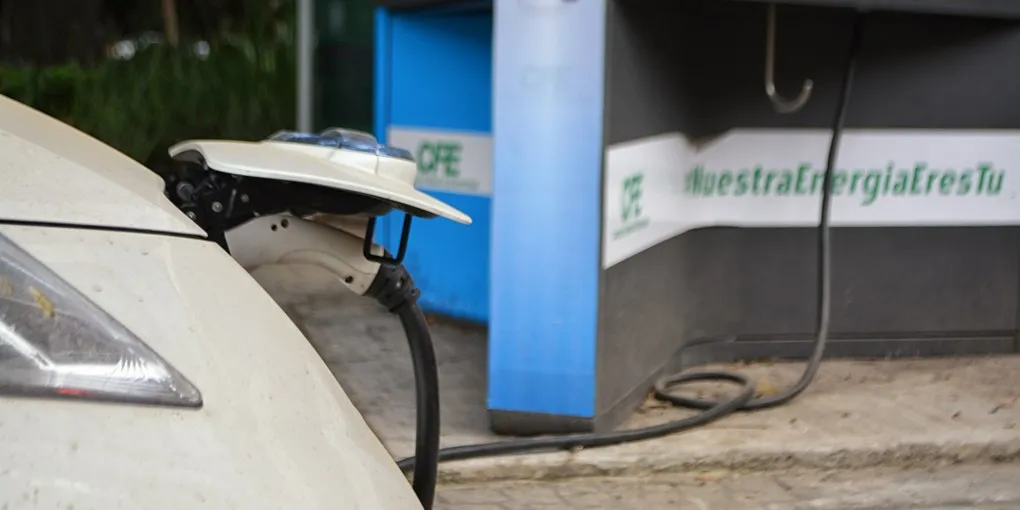
- Cover photo: “Parque España – Ciudad de México – Auto eléctrico en estación de carga” by ProtoplasmaKid, CC BY-SA 4.0; cropped and resized
