How to charge an EV battery: practical habits for longer life
For most electric vehicles, the best everyday charging target is the one recommended by the manufacturer—not a universal percentage. If the car recommends an 80% or 90% daily limit, use it and save 100% for trips that need the range. If it uses an LFP battery and asks for regular full charges, follow that schedule instead.
The reason is not that charging to 100% immediately “damages” a battery. The useful distinction is between reaching a high state of charge when needed and keeping the battery there for a long time, especially when it is hot. High cell voltage can accelerate unwanted reactions, but the size of the effect depends on the cathode chemistry, temperature, time, charge rate, and the battery-management system (BMS).
Practical charging guide
| Situation | Recommended action |
|---|---|
| Normal daily driving | Use the daily charge limit shown by the car or its app |
| Long trip | Charge to 100% if the extra range is useful, ideally finishing near departure |
| Car will sit for days | Avoid leaving it near 0% or 100%; use the storage guidance in the manual |
| Hot weather | Reduce unnecessary time at high SOC and let thermal management work |
| LFP battery | Follow the vehicle’s full-charge schedule; some models request 100% periodically |
| Public DC fast charging | Use it when it is useful; AC charging is a good default when time allows |
These are habits, not emergency rules. The BMS protects the pack from unsafe operating limits, and the displayed 0% and 100% normally describe the vehicle’s usable range rather than every cell’s absolute electrochemical limits.
What state of charge means
State of charge (SOC) is an estimate of the energy available in the battery. It is analogous to a fuel gauge, but it is calculated from voltage, current, temperature, cell behavior, and software models rather than measured directly.
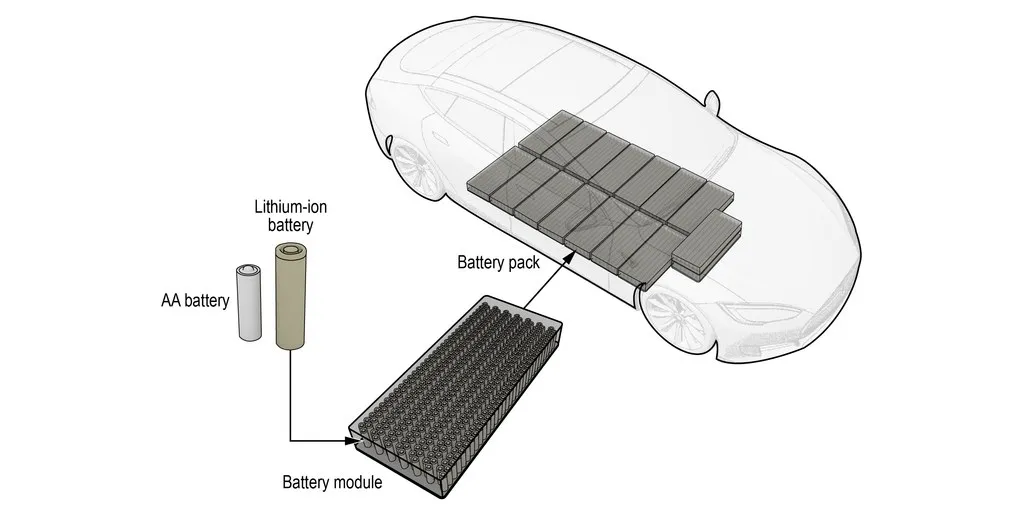
An EV battery pack contains hundreds or thousands of cells. Its BMS monitors them, balances their charge, controls heating and cooling, reduces charging power when necessary, and reserves operating margins. Automotive research distinguishes the pack’s gross capacity from the smaller usable capacity exposed to the driver; manufacturers can use that difference to accommodate degradation and protect the battery over its life (von Bülow, Heinrich and Paxton, 2024).
This is why 100% on the dashboard is not the same as forcing an unprotected laboratory cell beyond its safe voltage. It is also why a charge limit should be treated as a vehicle setting, not converted directly into a cathode voltage.
Why the upper charge limit matters inside a cathode
When a lithium-ion cell charges, lithium ions leave the cathode and move toward the anode. The cathode must remain structurally and chemically stable while its lithium content changes. Within its intended window, much of this process is reversible: lithium can return during discharge.
Near the upper voltage boundary, some cathode materials become more reactive. Possible degradation mechanisms include electrolyte oxidation, transition-metal dissolution, gas generation, particle cracking, and changes in crystal structure. High-nickel layered cathodes are one relevant EV example: phase transitions at high SOC can change particle volume, create cracks, expose new surfaces to the electrolyte, and contribute to capacity fade (Manthiram, 2020).
The exact mechanism is not the same in every battery. Still, the engineering tradeoff is broadly recognizable: accessing more energy at the top of the charge window can impose more stress than operating within a narrower window.
What the Li₂CuO₂ study found
The research that motivates this article examined lithium copper oxide (Li₂CuO₂) as a cathode material. It did not test a production EV battery, and Li₂CuO₂ is not a claim about every cathode chemistry.
In the experiment, electrodes cycled over a wide potential window of 1.5–4.2 V versus Li/Li⁺ reached approximately 140 mAh/g for 10 cycles. The researchers associated poor retention during extended cycling with irreversible oxygen-redox processes and structural changes. When they restricted the window to 2.0–3.8 V, those processes were minimized and the electrodes retained approximately 100 mAh/g for 60 cycles, with good rate recovery.
In other words, the narrower window gave up some immediately accessible capacity but preserved more repeatable operation. The result illustrates why battery engineers do not evaluate maximum capacity independently from cycle life (Ramos-Sanchez et al., 2017). Earlier structural work on the same material also reported irreversible decomposition into CuO and oxygen as lithium removal progressed beyond LiCuO₂ (Armstrong et al., 2011).
The defensible conclusion is specific: restricting the potential window reduced irreversible processes in the Li₂CuO₂ electrodes studied. The paper does not establish 80% as a universal EV charging limit, nor does it predict how many years an EV pack will last.
NMC, NCA, and LFP batteries need different routines
| Battery family | Everyday implication |
|---|---|
| NMC or NCA | Often benefits from a manufacturer-provided daily limit below 100%, with full charging reserved for needed range |
| LFP | Has a different voltage profile and strong structural stability; some vehicles request regular 100% charges so the BMS can maintain an accurate range estimate |
| Unknown chemistry | Check the vehicle, app, VIN information, or owner’s manual rather than guessing |
Manufacturer instructions make the difference concrete. The Tesla Model Y manual tells owners of vehicles with an 80% recommended daily limit to keep it around 80% and, when possible, not leave the battery near 0% or 100% for long periods. It separately tells owners to use the limits shown by their vehicle for the installed battery (Tesla Model Y Owner’s Manual).
Ford’s Mustang Mach-E guidance distinguishes NCM from LFP packs: it recommends a 90% everyday maximum for the NCM version, while the LFP version is set to 100% and should reach 100% at least monthly to maintain range accuracy (Mustang Mach-E Owner’s Manual). Kia guidance likewise varies by battery type and model, including an 80% recommendation for some packs and regular full-charge instructions for others (Kia High Voltage Battery guidance).
These examples should not be copied blindly to another EV. They show why the car’s own recommendation outranks a generic internet rule.
Temperature and time matter as much as the number
SOC alone does not determine battery aging. A full battery used promptly for a trip is a different condition from a full battery parked for days in high heat.
Calendar-aging tests on LFP–graphite pouch cells compared storage at 50% and 100% SOC at 25 and 50 °C. Higher SOC and higher temperature both increased capacity loss, with temperature producing the stronger effect in that experiment (Wang et al., 2025). This is one reason practical advice focuses on avoiding unnecessary time at high SOC rather than treating 100% as forbidden.
Cold creates a different concern. Charging a very cold cell at high power can increase polarization and the risk of lithium plating. EVs can manage this by preconditioning the battery and limiting charge power. If the navigation system offers battery preconditioning before a fast charger, use it.
EV battery maintenance and cooling-system care
An EV’s thermal-management system keeps the battery within its intended temperature range while driving, charging, and sometimes while parked. Depending on the vehicle, it can combine liquid coolant, pumps, valves, radiators or chillers, fans, sensors, and the air-conditioning compressor. The BMS may reduce charging speed or propulsion power when it cannot maintain the target temperature.
Owners do not need to keep a cooling mode manually switched on. The vehicle controls it automatically, and fans, pumps, or the air-conditioning compressor may run even after the car is parked. Those sounds alone do not indicate a fault. Tesla, for example, notes that its air-conditioning compressor also cools the battery and that coolant circulation while the vehicle is idle can be normal (Tesla maintenance guidance).
Use this maintenance checklist:
- Follow the model-specific service schedule. Coolant type and replacement intervals vary. Some systems use long-life coolant; others specify inspection or replacement by time or distance.
- Act on thermal-system and coolant alerts promptly. Reduced charging speed or power can be a protective response, but a persistent warning needs diagnosis.
- Check beneath the parked vehicle for an unfamiliar colored or oily fluid. Clear water from air-conditioning condensation is usually normal. If a coolant leak is suspected, do not open a reservoir or continue fast charging; arrange service.
- Keep external air paths reasonably clear. Leaves, mud, and heavy debris around an accessible grille or radiator area can restrict airflow. Follow the cleaning method in the owner’s manual and never reach near a fan, which may start while the car is off.
- Use scheduled departure and battery preconditioning. When the car is plugged in, this can prepare the cabin and pack using grid power and bring the battery toward a suitable temperature before driving or fast charging.
- Install software updates. Thermal controls and diagnostic logic are software-managed, so current vehicle software is part of maintaining the system.
- Have the system inspected after an underbody impact, collision, or flood exposure. The battery enclosure and coolant circuit can be affected even when exterior damage appears limited.
Do not open the high-voltage battery, disconnect orange cables, remove a battery-coolant cap, add a generic coolant, or use leak-sealing additives unless the owner’s manual explicitly identifies an owner-serviceable procedure. Tesla states that its Model 3 battery coolant requires no owner maintenance and directs owners to schedule service after a low-fluid alert (Tesla high-voltage battery information). Ford likewise warns that coolant must meet the vehicle specification and that driving while the electric motor is overheating can cause the vehicle to stop (Ford owner guidance).
If the vehicle displays a battery-overheating or stop-safely warning, reduce speed, pull over in a safe place, follow the on-screen instructions, and contact roadside assistance or service. Do not remove a coolant cap while the system is hot. Smoke, popping sounds, a sharp chemical odor, or visible vapor after a collision should be treated as an emergency: move away from the vehicle and call emergency services.
Direct best practices for EV owners
- Use the limit recommended by your EV. The vehicle knows its battery type, buffers, software, and thermal system.
- Charge to 100% when the range is useful. For a road trip, full capacity is a feature—not a failure.
- Finish a full charge close to departure. Scheduled charging reduces the time spent sitting at high SOC.
- Do not chase an exact percentage every day. A routine that is easy to maintain matters more than micromanaging individual percentage points.
- Avoid prolonged extremes. Recharge promptly after reaching a very low level, and avoid storing the car full unless its manual directs otherwise.
- Manage heat. Park in shade when practical, keep the car plugged in if the manufacturer uses shore power for thermal management, and avoid disabling battery conditioning.
- Prefer AC charging when it fits the trip. Use DC fast charging when its speed is valuable, and let the car control the safe charging curve.
- Follow LFP calibration instructions. A requested full charge can help the BMS estimate SOC accurately; it is not a contradiction of the chemistry discussed above.
The useful rule is “as much as you need, when you need it”
A charge limit is a way to trade unused daily range for less time at the battery’s highest operating voltage. The Li₂CuO₂ research provides a clear materials-level example: a restricted voltage window suppressed irreversible reactions and improved retention. Commercial EVs apply the broader idea through cathode selection, usable-capacity buffers, thermal control, charging curves, and BMS software.
For an owner, the practical conclusion is simple: use a moderate daily limit when your vehicle recommends one, charge fully when the trip calls for it, minimize unnecessary time at high SOC and high temperature, and follow chemistry-specific instructions from the manufacturer.
Sources
- Ramos-Sanchez et al., “Controlling Li₂CuO₂ single phase transition to preserve cathode capacity and cyclability in Li-ion batteries,” Solid State Ionics (2017)
- Armstrong et al., “Structural originations of irreversible capacity loss from highly lithiated copper oxides,” Journal of Solid State Chemistry (2011)
- Manthiram, “A reflection on lithium-ion battery cathode chemistry,” Nature Communications (2020)
- von Bülow, Heinrich and Paxton, “The future of battery data and the state of health of lithium-ion batteries in automotive applications,” Communications Engineering (2024)
- Wang et al., “Deciphering the Calendar Aging Degradation Mechanism of LiFePO₄-Graphite Pouch Cells,” ACS Applied Energy Materials (2025)
- Tesla Model Y Owner’s Manual: High Voltage Battery Information
- Ford Mustang Mach-E Owner’s Manual: Preserving Your High Voltage Battery
- Kia Owner’s Manual: High Voltage Battery
- Tesla Model 3 Owner’s Manual: Maintenance Service Intervals
- Tesla Model 3 Owner’s Manual: High Voltage Battery Information
- Ford Owner’s Manual: coolant and electric-motor overheating guidance
- Cover illustration: NTSB graphic by Christy Spangler, public domain in the United States; resized to fit the site
.jpg)